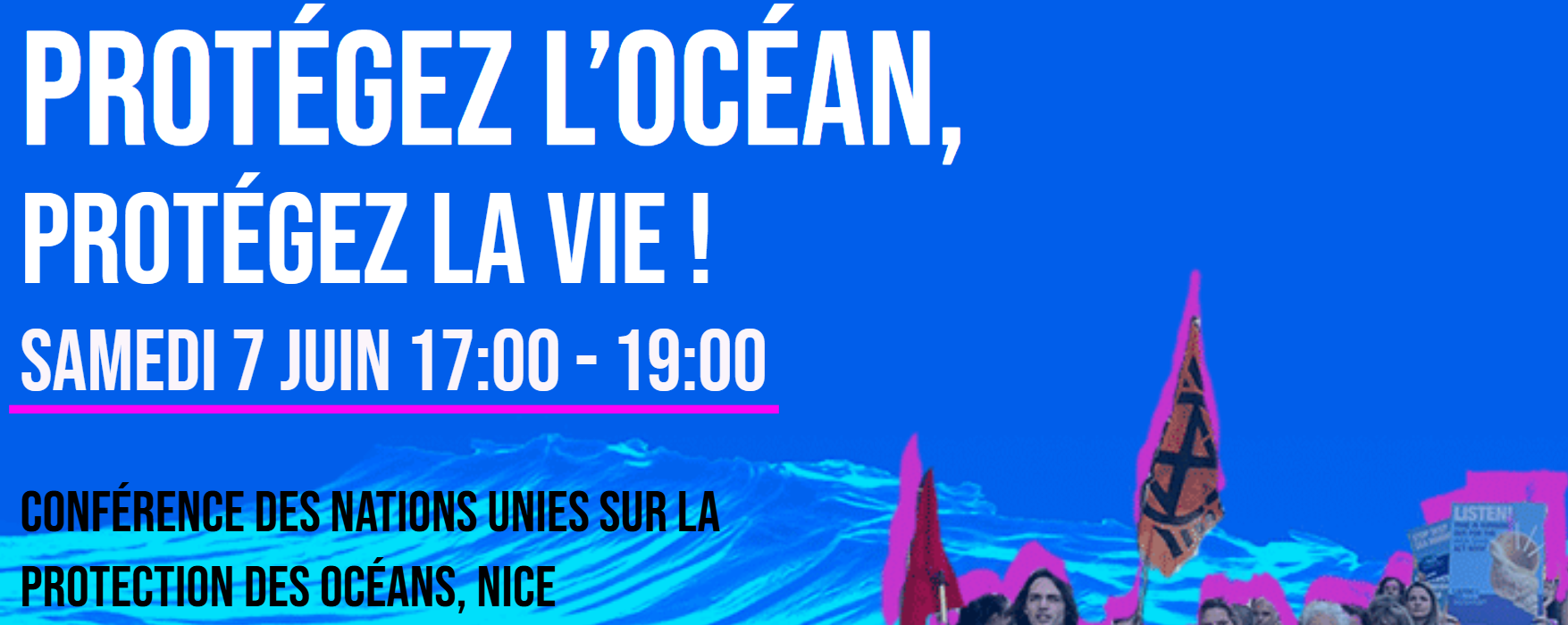
We expect immediate and decisive action from the heads of state gathered in Nice for the 3rd United Nations Ocean Conference to protect the ocean and, by extension, the planet, humanity, and future generations.
Foundation of all life on Earth, the ocean is fundamental to our survival and well-being. Oxygen production, carbon storage, food supply, climate regulation, and more: the health of the ocean is intimately linked to our own. Yet, today, it faces growing threats: overfishing and destructive exploitation, global warming, water acidification, and pollution.
We call for a paradigm shift where ocean protection becomes the norm, not the exception.
We demand:
Adopt the Protection Principle so that ocean protection becomes the rule rather than the exception. The burden of proof should fall on the various economic sectors, which must demonstrate that they have no negative impact on the environment, rather than on ocean defenders to provide evidence of damage after it has occurred. It is time to reverse the current paradigm of exploitation in favor of protection.
Marine protected areas must be truly protected and managed. Each country must ratify the “High Seas Treaty on Biodiversity Beyond National Jurisdiction” and create real marine protected areas in at least 30% of its waters by 2030, ending industrial activities, including industrial fishing, and particularly bottom trawling. These marine protected areas and their management must be defined with respect for the rights of indigenous peoples and local communities and based on their traditional ecological knowledge.
Accelerate the transition to low-impact fisheries that minimize negative climate, environmental, and social impacts and contribute to the restoration of marine ecosystems.
Prioritize coastal communities: Local coastal communities, Indigenous Peoples, and small-scale low-impact fisheries, and particularly women and youth, are on the front lines of the current triple crisis. Yet, they play a key role in biodiversity conservation, food security, climate resilience, and the fight against poverty. These communities must fully participate in the governance and management of biodiversity and natural resources, respecting their free, prior, and informed consent.
End harmful subsidies that contribute to degradation of marine environments. Subsidies for industrial fishing, oil and gas drilling, or other extractive activities, as well as tax exemptions on fuels for fisheries, must end. Unspent funds must be redirected to protection and restoration of marine ecosystems, as well as to the just and fair transition of impacted sectors, particularly fisheries.
Urgently reduce greenhouse gas emissions in line with the Paris Agreement to limit global warming to +1.5°C. Immediately ban all new offshore oil and gas exploration and production, and rapidly phase out existing offshore extraction.
Actively combat plastic pollution by supporting the adoption of a Global Plastics Pollution Treaty. Banning the use of single-use plastics, implementing a global plan to reduce plastic production, and banning hazardous substances in plastic products must be a priority.
Adopt a legally binding moratorium on deep-sea mining, both in territorial and international waters.
Promote Blue Justice: The blue economy must be regenerative, respectful of nature, and champion high social standards, quality jobs, gender equality, social inclusion, and end unfair competition between countries, for example in industrial fishing and ocean grabbing. The sea must be a democratic and safe space, including for the refugees who cross it.
IT IS TIME TO ACT!
We have a choice: Will we continue a destructive path? Or will we recognize the ocean as our best ally for a prosperous future?
Let us unite for strong ocean governance and greater protection.
ALL UNITED FOR THE OCEAN!
Posted on: 6 June 2025