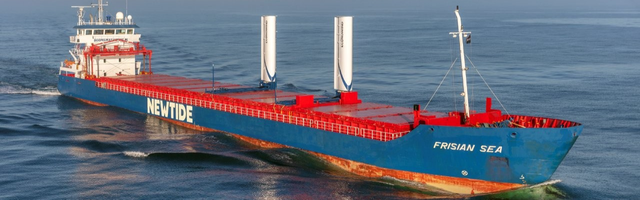
A landmark study commissioned by Seas At Risk, drawing on 1.74 billion kilometres of real voyage data, the equivalent distance from the Earth to Saturn, finds that wind propulsion could reduce modelled wind ship fuel use by 6.3–9.4% with even greater potential when combined with other measures. By 2050, it could deliver up to 762 million tonnes of cumulative CO₂ savings. The technology is ready. The gap is policy.
Until now, no study has assessed the decarbonisation potential of wind propulsion across the entire maritime fleet. This study addresses that gap and the findings are clear: wind propulsion is a commercially available, proven technology capable of delivering real emissions reductions today, before next-generation fuels become widely available or affordable.
Based on modelling of main engine emissions across the global fleet by the Tyndall Centre for Climate Change Research in Manchester, UK, wind propulsion could reduce annual CO₂ by 7.8% by 2050. That is the equivalent to removing up to 170 million cars from the road every year. But the speed of policy ambition will reflect the scale of impact, with potential CO₂ savings of up to 762 million tonnes by 2050.
Key findings
-
Significant, well-evidenced savings: Drawing on 1.74 billion km of real voyage data, wind propulsion can cut modelled wind-fleet-wide fuel use by 6.3–9.4%. These are conservative estimates; the true potential is greater when operational optimisation is applied, such as weather routing, slow steaming, hull optimisation for newbuild vessels and primary wind designs.
-
Bulk carriers and tankers first: The top 16% of vessels, predominantly bulk carriers and tankers, deliver 50% of total emissions savings. Targeted policy support for these ship types can unlock disproportionate near-term gains.
-
Reducing pressure on future fuel supply chains: Every tonne of fuel avoided through wind propulsion eases constraints on scarce e-fuel production, supports a more equitable transition, and allows renewable electricity to serve priority uses first.
-
Policy is the bottleneck, not technology: Without stronger incentives, wind propulsion delivers only 0.2% emissions reduction by 2050. The IMO’s Net-Zero Framework must reward real, early reductions and limit the use of trading mechanisms as a substitute for genuine progress. At the same time, strengthening/tightening the Carbon Intensity Indicator (CII) is critical to encourage the installation of wind assisted propulsion systems
-
Waiting is not a strategy: Decarbonisation goals set out in the International Maritime Organization (IMO)’s greenhouse gas strategy are coming up fast: 30% emission reduction by 2030, 80% by 2040 and fully decarbonised by 2050. Most ships operating in the 2030s are already in service. Retrofitting them now builds skills, supply chains, and momentum while locking in real cumulative reductions during the critical decade ahead. It also directly supports the IMO’s commitment of at least 5% – striving for 10% – uptake of zero or near zero emission technologies, fuels and energy sources by 2030.
Anaïs Rios, Senior Shipping Policy Officer, Seas At Risk says “The ships needed to reach 2030 climate targets are already at sea and they can be powered by wind. Retrofitting sails cuts fuel use and emissions now, while alternative fuels remain decades away from being available at scale. Wind propulsion is not a future option, it’s a solution we can deploy today. The priority is to scale it up and ensure the transition is fair and accessible to all”
Dr James Mason, Research Associate, Tyndall Centre for Climate Change Research at the University of Manchester says “This is the most comprehensive study undertaken to date on how wind propulsion can scale up and contribute to decarbonising the maritime fleet. Using advanced modelling techniques and real operational data, we have shown that a targeted deployment on top-performing vessels can provide meaningful CO2 savings. If scale up of the technology is supported over the next critical decade, wind propulsion could play a vital role in reducing cumulative emissions and limiting the maritime sector’s contribution to ever worsening climate change impacts.”
Policy recommendations
For wind propulsion to deliver its full potential, IMO and EU policy frameworks must be structured to reward real, early emission reductions. As the IMO is about to restart global decarbonisation negotiations, Seas At Risk calls for:
-
Real, verified savings recognised: Fuel and emissions savings must be fully reflected in ships’ GHG performance, including through the IMO’s Carbon Intensity Indicator (CII), so that wind-assisted vessels see a clear improvement in carbon intensity ratings.
-
Action more attractive than paying: *Remedial units must be priced at a level that makes investment in real solutions, such as wind propulsion, consistently more attractive than purchasing compliance.
-
Flexibility mechanisms must not replace real progress: Limits on **Surplus Unit trading are essential to ensure each ship retains a clear incentive to reduce its own emissions, rather than buying its way to compliance.
-
Revenues directed toward immediate solutions: Funds must support retrofit technologies such as wind propulsion, operational optimisation – such as vessel speed reduction and weather routing -, and capacity-building — with particular attention to enabling access in developing countries, especially SIDS and LDCs, to support a more equitable transition.
Shipping pollution is global. So is responsibility. The IMO’s Net-Zero Framework represents a critical opportunity to move from ambition to action. This study shows wind propulsion is ready to play a major role but only if policy is designed to reward those who act early and act genuinely.
Full study available at: https://seas-at-risk.org/wp-content/uploads/2024/09/A-global-Fleet-Under-Wind_Seas_At_Risk-1.pdf
*Remedial Units (RUs): Credits that ships must purchase from the regulator when they exceed emissions limits. They act as a penalty for non-compliance and are designed to be priced high enough to encourage real emissions reductions rather than paying to pollute.
**Surplus Units (SUs): Credits earned by ships that perform better than emissions targets. These can be used later or transferred to other ships, providing flexibility while rewarding early and real emissions reductions.
Posted on: 16 April 2026