A new study reveals that the EU fishing fleet can make an ambitious transition away from fossil fuels without increasing the existing ceiling on the capacity of the EU fishing fleet (1). Established based on the vessels’ gross tonnage and engine power, this ceiling determines the total fishing capacity that each Member State’s fleet can have, and it is an essential safeguard against overfishing (2). The study demonstrates that there is no need to reform the Common Fisheries Policy to enable the fleet’s decarbonisation.
The study, carried out by Profundo and commissioned by Seas At Risk, finds that there is enough unused capacity within existing national fleet-capacity ceilings to accommodate the additional space required for the transition to low-carbon propulsion technologies. For example, methanol requires larger fuel tanks and additional safety space compared with conventional diesel engines, while electric propulsion systems require substantial additional storage capacity (3). This finding is particularly relevant because the additional space required by low-carbon technologies has been used to argue that these capacity ceilings need to be increased.
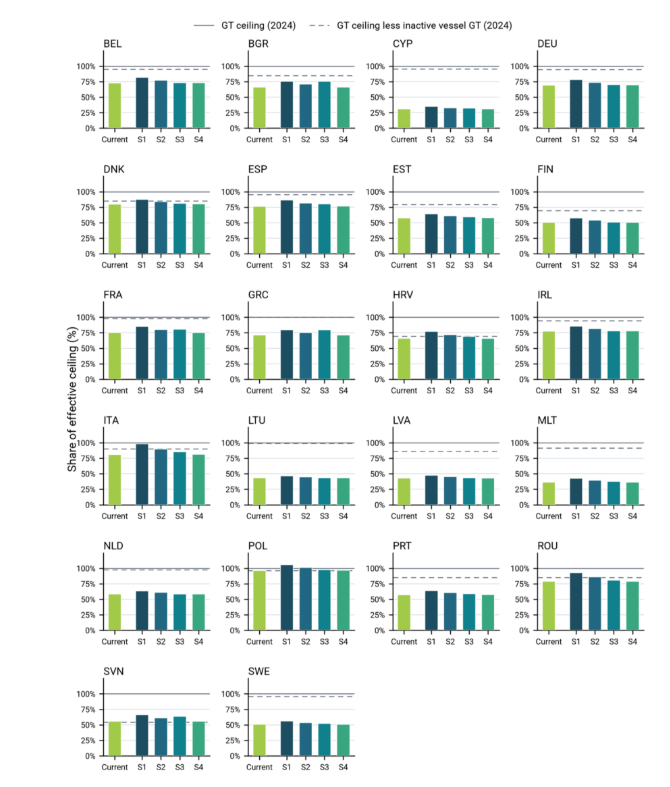
According to the study, even under the most ambitious decarbonisation pathway modelled, the EU fleet remains well below the existing capacity ceilings. Only Poland exceeds its capacity ceiling in the most ambitious scenario, and even there the projected excess is marginal and unlikely to pose a practical constraint (4). The modelling therefore shows that the energy transition does not require an increase in existing fleet capacity ceilings.
Capacity ceilings are a core safeguard of the Common Fisheries Policy, introduced in response to the well-established link between excessive fishing capacity and overfishing. By limiting the capacity that Member States can maintain, they help prevent fleets from becoming too large relative to available fishing opportunities, supporting a sustainable balance between fleet capacity and fish stocks.
The need to maintain these safeguards remains crucial. According to a 2026 assessment by the European Environment Agency’s European Topic Centre on Biodiversity and Ecosystems, only 32% of assessed commercial fish and shellfish populations in EU marine waters were both sustainably fished and in good condition in 2023. The assessment also found that fishing pressure remains too high to allow full recovery of populations (5). Weakening or removing these ceilings would risk reopening the structural overcapacity that the Common Fisheries Policy was designed to address and undermine efforts to keep fishing pressure within sustainable limits. (6)
Furthermore, the study’s findings are particularly relevant as oil prices remain volatile and the EU cannot indefinitely rely on public funding in the form of subsidies to shield a sector heavily dependent on fossil fuels. Seafood prices are also closely linked to oil prices, further exposing the sector to energy price shocks. This makes the transition away from fossil fuel dependence increasingly urgent, as the EU prepares its Vision for Fisheries and Aquaculture 2040 and Energy Transition Roadmap, and as discussions continue on the future of the EU Common Fisheries Policy. (7)
“The evidence is clear: the EU fishing fleet can decarbonise without increasing fleet capacity ceilings. There is no need to weaken this important safeguard and to reform the Common Fisheries Policy, and we urge EU policy-makers to keep existing capacity limits in place,” said Bruno Nicoastrate, Senior Fisheries Policy Officer at Seas At Risk. “The priority now must be to accelerate the transition towards low-impact, low-carbon fisheries.”
Table: Gross Tonnage impact and ceilings. Member state detail. Profundo modelling of fuel alternatives for the EU fishing vessel fleet.
ENDS
NOTES:
- “Can the EU fishing fleet be decarbonised without raising capacity ceilings?” The study is the first quantitative assessment covering the entire EU fleet.
- The EU’s fleet-capacity limits are rooted in a long history of excessive fleet capacity and fishing pressure. A 1998 review of the Common Fisheries Policy found around 40% overcapacity and concluded that a drastic reduction of the fleet was urgently needed. (Ref)
- Almost every alternative fuel requires more onboard space than marine diesel. Examples: methanol requires substantially larger tanks plus safety spaces; batteries require significant battery volume; hydrogen/ammonia require even larger storage capacity. Report, section 3.2, page 11.
- See table 6 from the report. Gross Tonnage impact and ceilings. Member state detail. Profundo modelling of fuel alternatives for the EU fishing vessel fleet. Moreover several segments of Poland’s fishing fleet are already showing signs of imbalance with available fishing opportunities, as some of the targeted fish populations are already being fished above sustainable levels. Report page 26. Original source (ref).
- According to a 2026 assessment by the European Environment Agency’s European Topic Centre on Biodiversity and Ecosystems, only 32% of assessed commercial fish and shellfish populations in EU marine waters were both sustainably fished and in good condition in 2023. The assessment also found that fishing pressure remains too high to allow full recovery of populations. (ref)
- In 2002, the European Parliament noted that the size of many fish populations and catches had declined dramatically over the previous 25 years, while fishing capacity far exceeded what could be sustainably supported. The 2002 CFP reform strengthened the requirement to bring fishing capacity into balance with available fishing opportunities. (Ref) (ref)
- See the European Commission’s Vision for Fisheries and Aquaculture 2040 and the Energy Transition Roadmap for EU fisheries and aquaculture, which sets out the pathway towards a more energy-efficient and climate-neutral sector.
Press release in Spanish. Press release in Portuguese.
Posted on: 7 September 2026