Whose voice carries in discussions on shipping? Who sits at the policy-making table? And who will be left behind as the shipping world begins its green transition?
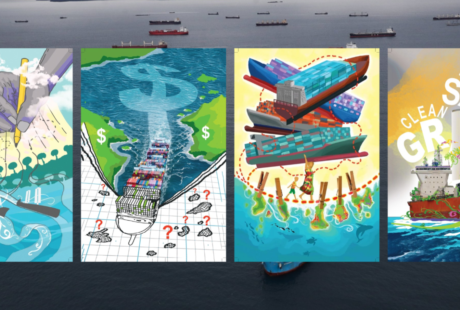
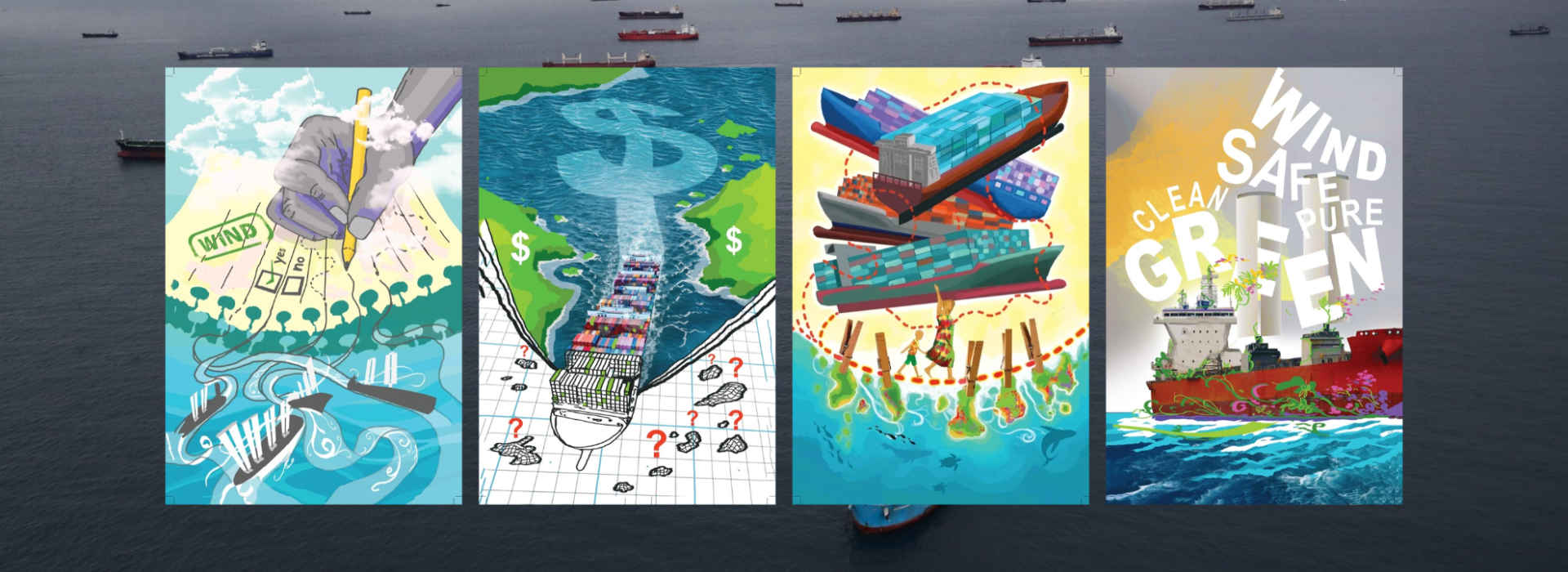
Earlier this year, Seas At Risk commissioned four postcard designs from Dominican artist Nicole Morson in the lead up to an International Maritime Organization meeting on shipping decarbonisation. The postcards underscore how small island communities are facing climate impacts that they did not create, while solutions already exist.
On one postcard, a hand pencils a line that feeds directly into the wake of a fleet of wind-propelled ships. Above the ships, a bright green tick has been made in the ‘yes’ box, while the ‘no’ box sits empty. On another postcard, a person dressed in traditional Caribbean cloth carries four cargo ships on their shoulders as they walk across a red dotted line. The red line acts as a clothesline for small island states, hanging above a diverse, if ever encroaching, ocean.
Nicole comes from Dominica, a small island between Guadeloupe and Martinique in the Caribbean. In addition to Nicole, it’s home to nearly sixty-six thousand people and a wide variety of plants and animals on land and at sea. According to her, this diversity is why it’s known as ‘Nature Island’.
But as global temperatures climb, Dominica’s residents face growing threats: rising sea levels, declining marine biodiversity and intensifying storms are proving increasingly deadly.
So what can we do?
The problem with shipping
Although commonplace in our extremely connected world, maritime transport has ballooned in the past fifty years, from about “2605 million tons of cargo transported in 1970 to around 11000 million tons in 2021“. Maritime transport now makes up 80% of world trade, with most countries dependent on shipping to cheaply supply everything from Labubus to fruit to car parts.
Small Island Developing States (SIDS), especially those in the Caribbean, are highly dependent on shipping to support their populations, with one researcher calling them ‘trapped by the global shipping industry’. Unsurprisingly, SIDS rely on shipping for consumer items and exports, but also for critical goods like food, energy, and construction materials. Indeed, due to their small port sizes and slower turn-around time, most SIDS are actually forced to pay more for their exports and imports than competitors in the United States, Europe or East Asia.
Adding insult to injury, despite accounting for less than 1% of global greenhouse gas emissions, SIDS are disproportionately affected by climate change’s impacts. Between 2000 and 2024, climate change caused USD$57bn in economic loss and damage to SIDS, up to five times higher than other countries in the same income bracket. And these costs are rising.
For people like Nicole who live in small island states, greenhouse gas emissions are not simply an economic by-product of global trade: they mean the loss of homes and jobs, polluted waters, and serious health complications.
Decarbonisation for all?
To reduce its impact on the environment and associated costs, the shipping industry is now exploring decarbonisation options, such as innovative technology, e-fuels, wind propulsion and more.
In fact, this winter is set to be very influential in the shipping decarbonisation world as the International Maritime Organization’s (IMO) Marine Environment Protection Committee (MEPC) will meet to review, amend and hopefully adopt a Net-Zero Framework (NZF) this month, following COP31.
The NZF aims to regulate greenhouse gas emissions from ships by introducing, among other things, a global fuel intensity standard, a dual compliance mechanism, and crucially, the IMO Net-Zero Fund. If adopted, the NZF would be the first ever legally binding global emissions regulation for any sector. This would make it a pioneer in climate regulation and a potential trailblazer for any other sectors to follow.
With the IMO aiming for total net-zero shipping emissions by 2050, the NZF marks an important step in the right direction – but not without serious amendments.
The problem, at its core, is two-fold: first, the measures introduced are simply not enough to meet the minimum emissions targets that the IMO has set itself. There are no restrictions on the use of fossil fuels, its application is severely limited, and ships can easily bypass paying for their pollution. The IMO itself has set a target of 20-30% emissions reduction by 2030, but this framework will only reduce emissions by 10% at best.
Second, the Net-Zero Fund, set up to help climate-vulnerable SIDS and least developed countries (LDCs) decarbonise, is undermined by opaque decision-making and allocation processes. Now it seems that the Fund is to be further degraded as bigger states push back.
Without financial support, countries like Dominica will fall behind. In a 2023 report, UNCTAD estimated that USD$8 – 28bn will be needed every year to decarbonise ships by 2050, aligning with the IMO’s target, and a further USD$28 – 90bn will be allocated to developing sufficient carbon-neutral fuel infrastructure. In the same report, UNCTAD noted that fuel prices could skyrocket by 70-100%, negatively impacting SIDS and LDCs’ ship-reliant economies.
What’s more, despite existentially depending on shipping and feeling its environmental impacts more intensely, voices from SIDS are categorically marginalised when crafting global shipping regulation like the NZF.
In sum: SIDS and other climate-vulnerable states dependent on maritime transport are required to overcome high entry barriers to shape legislation, whilst being routinely overshadowed by larger states, and denied the means to transition, yet they face the greatest costs.
The answer is not to scrap the NZF, but to rewrite it to ensure a just and equitable transition that aligns shipping with the 1.5°C global target.
The way forward
As IMO delegates prepare to meet in a few weeks, a lot is at stake. The adoption of the NZF, delayed by a year, is on the table again and its consequences will be felt far beyond London.
As it stands currently, the Framework fails both people and planet. If delegates allow further amendments to water down its already limited gains, they endanger the lives and livelihoods of people who are not responsible for climate change, but who will suffer from it the most.
To this end, the NZF must be redrafted: providing real guardrails on emissions accounting, fuels and compliance, and securing meaningful support for developing countries so that everyone can be part of the green transition.
Amidst a looming super-El Niño set to impact the planet, people and trade routes connecting them, we need a Net-Zero Framework that actually meets existing climate goals, and a robust Fund to ensure that no one is left behind in the transition.
This could be our last chance.
Posted on: 17 November 2026