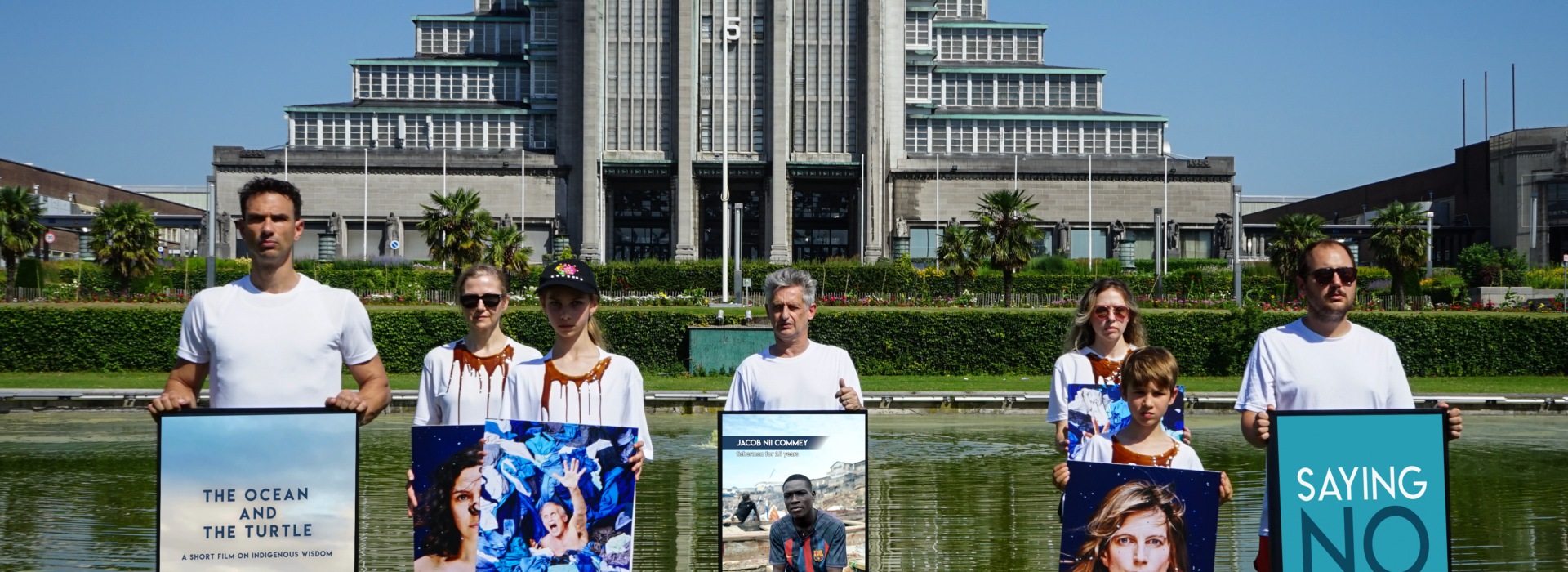
As thousands of industry representatives gather in Brussels for the Textiles Recycling Expo Europe, ocean protection NGO Ocean. Now!, together with Break Free From Plastic, Seas At Risk, Fashion Revolution Germany and Fashion Revolution Belgium, staged a public intervention calling for systemic change in the fashion industry.
Through the performance “Oil Drip Ritual”, the organisations seek to expose the hidden costs of fossil fashion. Behind industry claims of circularity and recycling lies a business model built on ever-growing volumes of fossil-fuel-based synthetic fibres. This dependence on oil and gas accelerates climate change, microplastic pollution, fashion waste and threatens biodiversity, ecosystems and human health. At the same time, communities in countries receiving large volumes of textile waste are increasingly bearing the environmental and health burdens of a system from which they derive little benefit.
On June 24 and June 27, participants dressed in white polyester t-shirts will gather in public spaces in Brussels as dark liquid resembling crude oil slowly drips onto their clothing. The silent performance reveals the hidden origins of synthetic fashion and serves as a stark reminder that every polyester garment begins as a fossil fuel. While the organisations welcome efforts to improve textile recycling, they warn that recycling alone cannot solve the environmental and social impacts of a fashion system driven by overproduction, overconsumption and continued dependence on virgin fossil-based materials.
The intervention is part of Ocean. Now!’s international campaign “Under Our Skin – Microplastics in Fashion”, which shines a light on the environmental, social and health impacts of polyester production, consumption and disposal through art, public engagement and policy advocacy.
A visual response to the limits of recycling
The action coincides with the Textiles Recycling Expo Europe in Brussels, one of the largest industry events dedicated to textile recycling and circularity.
Polyester, the world’s most widely used textile fibre, accounts for 57% of global fibre production and is made from fossil fuels. As production continues to grow, so too do its associated challenges, including
greenhouse gas emissions, microplastic pollution and increasing volumes of textile waste.
The organisations behind the action warn that an overreliance on recycling risks obscuring the root causes of the crisis. Without measures to reduce overproduction, phase down the use of virgin fossil-fuel-based materials and extend product lifetimes, recycling initiatives will struggle to keep pace with the scale of the problem.
“Recycling has a role to play, but it cannot solve a crisis driven by endless production of synthetic materials. Polyester remains plastic, whether virgin or recycled, and continues to release microplastic fibres into the environment. We need policies that address the fibre problem at its source and reduce our dependence on fossil-fuel-based materials. You cannot recycle your way out of a fossil-fuel problem,” said Meike Schützek, founder of Ocean. Now!.
The global consequences of overproduction
Beyond fossil fuel dependency and microplastic pollution, the organisations highlight the social and environmental consequences of the global fashion waste trade.
Every year, millions of tonnes of used clothing are exported from Europe and other high-income regions to countries in the so-called Global South. While some garments are reused, large quantities become unsellable and turn into waste, overwhelming already stretched local waste management systems. Driven by the overproduction and overconsumption of fast fashion, environmental and public health concerns are mounting in many textile waste receiving regions.
Through its Under Our Skin campaign, Ocean. Now! has documented the impacts of textile waste in Ghana, one of the countries most affected by imports of second-hand clothing. Large volumes of discarded garments end up in unengineered dumpsites, waterways and coastal ecosystems, contributing to a health crisis and environmental, economic and social burdens for local communities.
Ocean. Now!, Seas At Risk, Break Free From Plastic, Fashion Revolution Germany and Fashion Revolution Belgium argue that the current fashion system externalises its costs on those least responsible for the crises. They describe this injustice as “fashion waste colonialism”.
“While the impact of waste colonialism is devastating, it’s only one side of the story. The supply chain behind fast fashion is just as damaging. From toxic chemicals and massive carbon footprints to worker exploitation, the damage is widespread. To fix this, we need stronger laws – like extended producer responsibility (EPR) and stricter supply chain regulations – to ensure brands are held accountable, from production to disposal,” said Hellen Dena, project lead for the Pan-African Plastic project at Greenpeace Africa.
Urgent need for action and regulation
Against the backdrop of ongoing European discussions on circular textiles, ecodesign and microplastic pollution, the organisations behind the action are calling for a broader policy response that addresses the root causes of the crisis rather than its symptoms alone.
The organisations are calling for measures that:
- reduce dependence on virgin fossil-fuel-based materials
- curb the overproduction of textiles
- address overconsumption
- incentivise new fashion market models such as renting, swapping, repairing, upcycling
- strengthen producer responsibility across the full lifecycle of textile products
- support non-toxic and biodegradable materials
- prevent microplastic pollution at source
- ensure that environmental and social impacts are not externalised to communities least responsible for the problem
Without binding regulation, the organisations warn that recycling initiatives alone will struggle to keep pace with the continued growth of synthetic textile production. “Microplastic pollution from synthetic textiles is a hidden but growing threat to ocean health. These tiny fibres are invisible, yet they are now found in the world’s ecosystems, harming marine life and ultimately ending up in our own bodies. If we are serious about protecting the ocean, we cannot focus on waste management alone. We must address the root causes of the problem by reducing the production of fossil-fuel-based synthetic fibres and ending mass synthetic production that drives this pollution,” said Frédérique Mongodin, Senior Marine Litter Policy Officer, Seas At Risk.
Deep dive into the impact textiles have on ocean health here.
Posted on: 24 June 2026