The Whale Would Like a Word
There is a whale lying outside the European Parliament. It is impossible to miss. And that is precisely the point.
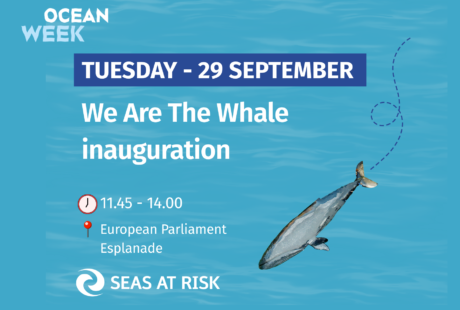
As Ocean Week 2026 starts this Monday 28 September, Seas At Risk is bringing a life-sized whale to the heart of the EU quarter. We Are the Whale is an interactive installation, but it is also a political declaration: a reminder that the ocean cannot keep being treated as an afterthought while decisions made inside the European Institutions determine its future.
The whale, an impressive artwork that has already “washed ashore” at different locations across Belgium, has now arrived in the heart of the EU – at the right time! This autumn is crunch time for the ocean in EU decision-making.
The EU has promised a lot
Europe already has no shortage of ocean strategies, targets and promises. But ambition on paper has never been the ocean’s problem. Implementation is.
The Blue Manifesto, backed by more than 140 organisations, has provided the EU with a roadmap for restoring a healthy, climate-resilient ocean by 2030. In June 2025, the European Commission presented their long-awaited Ocean Pact which laid out the planned work for the current mandate.
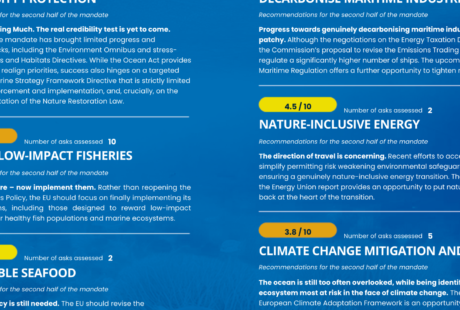
Two years in, a recent assessment finds that the outcome is still far from reassuring. Painfully little progress has been made. The EU is still not moving at the scale or speed required to turn its ocean ambitions into reality.
The Ocean Act must bring everything together
The Commission has committed to presenting a brand-new Ocean Act by the end of 2026, with the proposal intended to bring the EU’s ocean-related objectives and frameworks under one umbrella. We are hoping it will become the EU’s overarching law for the ocean, including modernisations of the Marine Strategy Framework Directive and the Marine Spatial Planning Directive.
This must be matched by decisive financial action in the upcoming Multiannual Financial Framework (MFF). As the EU prepares to set its budget for 2028–2034, we face critical questions about whether sufficient public funding will be allocated to restore marine ecosystems, protect blue carbon habitats and enable a just transition towards a regenerative blue economy. Without a significant shift in financial priorities, including phasing out harmful subsidies, even the strongest legislation will remain an empty promise.
Implementation remains key
The Common Fisheries Policy is a clear reminder of what is at stake when commitments are not fully translated into action. The EU has the tools to end overfishing – a crucial form of climate action – while also giving preferential access to coastal waters to low-impact fishers and putting ecosystem-based fisheries management into practice. A decade after the adoption of the ‘2013’ Common Fisheries Policy, it is time to turn these commitments into reality and ensure that the rules are properly implemented. With calls to ‘simplify’ EU ocean governance growing louder in Brussels, this is hardly the moment to reopen rules that still have not been put in place. Doing so risks turning simplification into a highway to deregulation, opening a Pandora’s Box of yet more rollbacks in a time when we cannot afford less ocean action.
Ocean Week is coming to town
Ocean Week 2026 is structured around one single call to action: Delivering on Ocean Health for Europe’s future. As the EU prepares its Ocean Act, anticipated in December, this week underlines that a healthy ocean must be at the heart of Europe’s future resilience, blue economy and environmental sustainability.
With the whale, we bring this to light through three pillars that are not merely policy preferences, but existential necessities for our future.
- Ocean and Climate Regulation is the foundation of our survival; the ocean absorbs the vast majority of excess heat and carbon we produce. Without protecting the ocean as our primary climate regulator, all other climate goals are mathematically impossible to achieve.
- Biodiversity and Ecosystem Restoration is the only path to resilience. Our ocean is overexploited and polluted, leading to a collapse of the natural systems that support fisheries, coastal protection and, in turn, human health. We cannot afford to treat symptoms – we must decisively restore ecosystem functions to ensure they can withstand future shocks.
- A just transition to a Regenerative Blue Economy is the only model that ensures long-term economic viability. The current “take-and-waste” approach is an economic dead end that depletes the very capital ocean industries rely on. A truly sustainable blue economy must align profit with regeneration.
The whale is watching
Whales are the ocean’s most visible giants, but their fate is tied to a myriad of pressures that are often almost invisible from Brussels: warming seas, bycatch, ship strikes, underwater noise and ocean pollution.
Whales are also vital for the ocean’s life-support system. As they dive and feed in the deep ocean, whales bring nutrients back to the surface through a process known as the “whale pump”. These nutrients fertilise phytoplankton – tiny organisms that absorb large amounts of carbon dioxide and produce much of the oxygen we breathe. In this way, whales help sustain marine life while also contributing to the ocean’s role in regulating the climate.
By addressing the multiple threats and restoring whale and other marine wildlife populations, we do not just save a species. We actively repair the ocean’s ability to cool the planet and regenerate its biodiversity.
The whale also carries a message of hope. The global moratorium on commercial whaling stands as a rare example of international cooperation where humanity chose to step back from the brink. This success proves that political will can shift the trajectory of a global threat.
Today, we argue that this same spirit of caution and foresight must be replicated. Just as we ended the slaughter of whales to allow their populations to recover, we must fully implement the ocean rules already in place, including the Common Fisheries Policy; protect and restore marine ecosystems by tackling destructive activities such as bottom trawling, whale strikes from ships and plastic pollution; and prevent new threats, including deep-sea mining. This autumn, Europe’s institutions will make choices that could shape the future of the ocean and climate for years to come.
The whale is watching. So are we.
Seas At Risk and IOBZ are working together to explore the connection between ocean protection, climate change and our own well being. The ocean sustains life far beyond its shores. It regulates climate, supports marine biodiversity, and provides space for connection, wonder and restoration. Yet as human pressures take their toll on marine ecosystems, we risk losing not only nature, but our connection to it.
By bringing together science, policy and art, Seas At Risk and IOBZ aim to reconnect people with the ocean and inspire a different relationship with the natural world, based on care, connection and protection.
Posted on: 28 September 2026