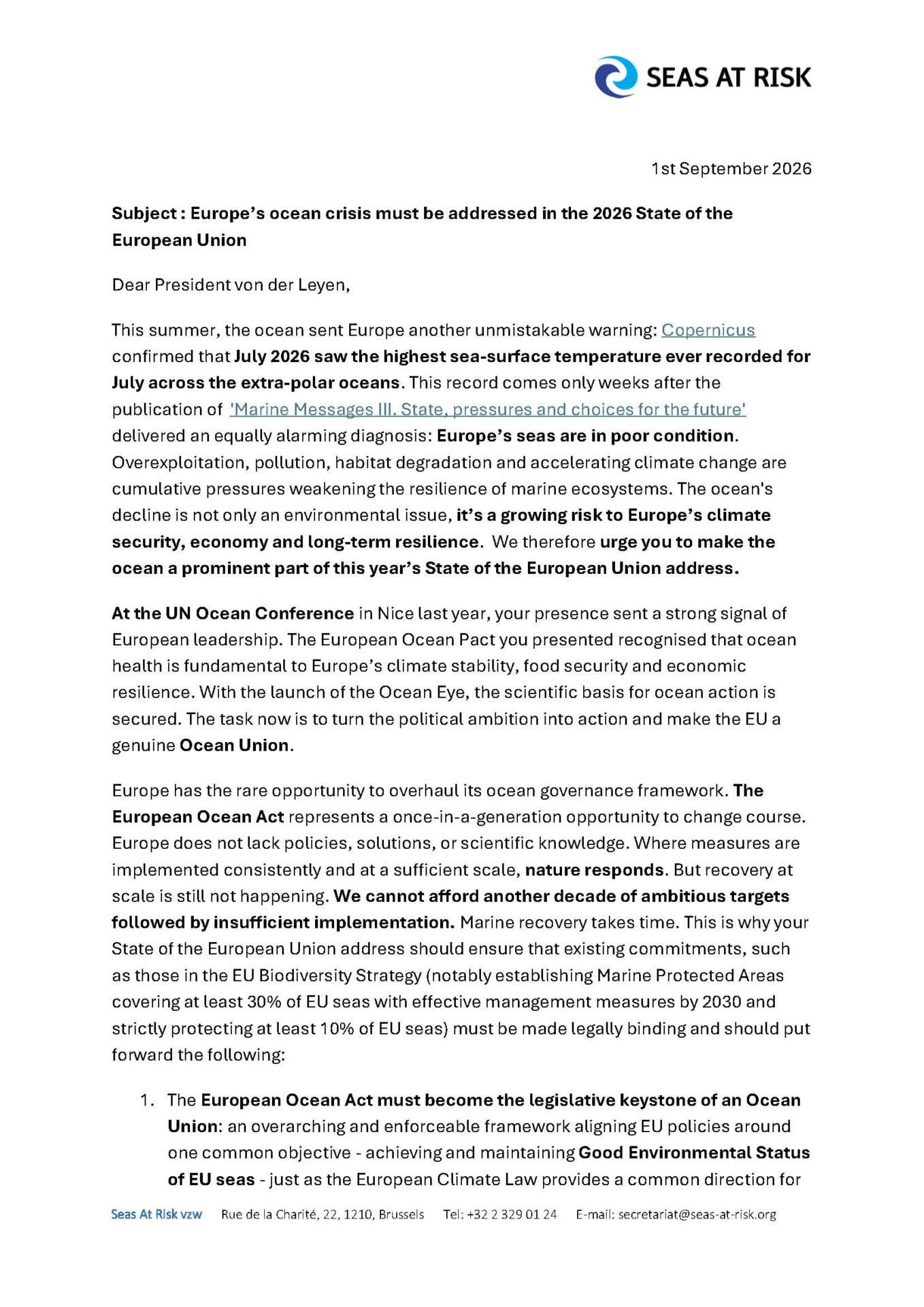
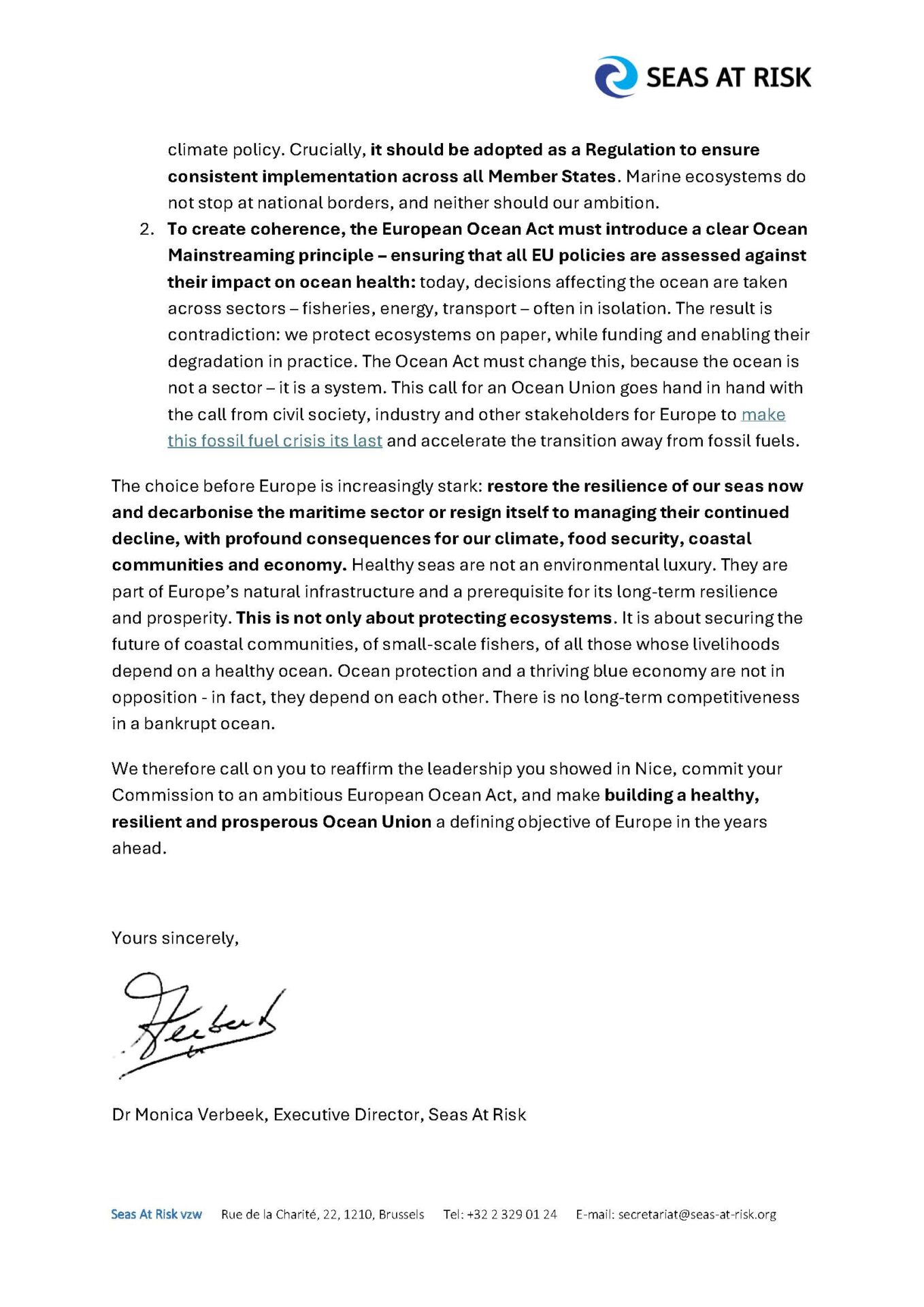
61 organisations, led by Seas At Risk, are calling on European Commission President Ursula von der Leyen to put the ocean high on Europe’s political agenda ahead of the 2026 State of the European Union address. The organisations call on the President to deliver an ambitious European Ocean Act that turns political commitments into concrete, enforceable action to restore Europe’s seas, and turn the EU into a real Ocean Union.
In an open letter to President von der Leyen, the organisations warn that Europe is approaching a critical moment for the ocean. The European Ocean Act, whose publication will coincide with the upcoming revisions of the Marine Strategy Framework Directive (MSFD) and Maritime Spatial Planning Directive (MSPD), amounts to a major overhaul of the EU’s ocean governance framework – and a once-in-a-generation opportunity to get it right.
Dr Monica Verbeek, Executive Director, Seas At Risk, says: “Europe’s competitiveness will be dead in the water along with the fish if we continue to push our seas beyond their limits. We need an Ocean Act with teeth. One that puts ocean health at the heart of European decision-making and ensures EU policy works towards its recovery, not against it. A concrete Regulation can turn Europe’s promise into bold and binding action and deliver a resilient blue economy within ecological limits.”
Europe’s seas are in poor condition – and time for recovery is running out.
This summer provided yet another warning to decision-makers about the state of the ocean and climate: Copernicus confirmed that July 2026 saw the highest sea-surface temperature ever recorded across the extra-polar oceans. At the same time, the Marine Messages III report paints an alarming picture of European seas under cumulative pressure from overexploitation, notably from destructive practices like bottom-trawling, pollution, habitat degradation and accelerating climate change.
The 61 organisations are calling for the European Ocean Act to become the legislative backbone of a healthy and resilient Ocean Union, including:
- An overarching and enforceable framework aligning EU policies around one common objective: achieving and maintaining Good Environmental Status of EU seas
- Adoption as a Regulation to ensure consistent implementation across Member States
- Introduction of an Ocean Mainstreaming Principle, ensuring decisions taken on fisheries, energy, transport, environment and other sectors support rather than undermine ocean health
There are already many tools the Ocean Act can operationalise to turn this principle into concrete change at sea. This could include:
- Establishing preferential access areas within the 12-nautical-mile coastal zone for low-impact activities
- Better directing public support towards activities that contribute to ecosystem recovery
- Enable the coexistence of blue economy activities through multi-use when it can improve the state of marine ecosystems and support local communities
- Ensuring Marine Protected Areas are effectively protected from damaging activities rather than remaining “paper parks”
The Ocean Act doesn’t need to reinvent ocean policy. It needs to make it work. At the same time, the revisions of the MSFD and MSPD must strengthen – not dilute – the foundations of EU marine governance. The MSFD must remain the EU’s central environmental framework for achieving Good Environmental Status, while maritime spatial planning should become a stronger tool for organising activities at sea within ecological limits and delivering those environmental objectives.
Posted on: 1 September 2026